Austin entered August 2021 with the feeling that the worst of the pandemic might finally be behind it. Restaurants were busy, bars were reopening more fully, live music was returning and Austinites were once again filling patios and making plans for nights out. After a year and a half of cancellations and restrictions, the summer had begun to resemble the Austin people remembered. Then the Delta variant arrived with a force that changed the mood almost overnight.

By the first week of August, Austin and Travis County had moved back into Stage 5 of the local COVID-19 risk guidelines as cases and hospitalizations surged. On August 7 and 8, the city activated its emergency alert system to warn residents about the rapidly worsening situation and the strain being placed on local hospitals. The fact that Austin used an emergency alert system normally associated with disasters demonstrated just how serious the situation had become.

For Austin’s bar and restaurant scene, the timing was brutal. Businesses had spent the spring and early summer rebuilding their operations around the assumption that the return of customers would continue. Restaurants were reopening dining rooms, bars were getting busy again and music venues were bringing performers back. Many owners had spent months waiting for exactly this moment. Suddenly, they were being forced to reconsider how much normal activity they could safely handle.

The result was one of the strangest months in Austin’s recent nightlife history. The city was technically open, but the atmosphere around going out had changed. Restaurants and bars were voluntarily reinstating policies that had disappeared only weeks earlier. Some required masks. Others reduced capacity. Some kept indoor dining closed. Several music venues and bars began encouraging customers to wear masks or changed their operating procedures in response to the surge. Eater Austin documented a long list of local businesses that reinstated pandemic precautions during August, including Hotel Vegas, Volstead, Justine’s, Kinda Tropical, Salt & Time, Fresa’s and numerous coffee shops and restaurants.

That was a remarkable reversal.

Only a few months earlier, Austin’s hospitality industry had been desperate to get people back through the doors. By August, some of those same businesses were voluntarily telling customers to slow down.

The conflict was especially visible in Austin’s music scene. Live music had finally started returning after being devastated by the pandemic, and musicians, venues and fans were eager to reclaim the experience that had made Austin famous. But the Delta surge created new uncertainty for touring artists and local performers. Across the live-music industry, tours were being reconsidered, venues were adding vaccination or testing requirements and outdoor performances were increasingly viewed as safer alternatives. The national touring industry was experiencing exactly the same tension Austin was facing: everyone wanted live music back, but nobody knew how long the reopening could safely continue.

For Austin, that meant the city’s famous nightlife identity was suddenly caught between two realities. The old Austin wanted packed clubs, crowded dance floors and late nights on East Sixth Street. The pandemic-era Austin had learned that those environments could become difficult to manage during a major COVID surge. Businesses had to make decisions that weren’t simply about money anymore. They were decisions about whether they could continue operating in a way that protected employees and customers while still keeping the doors open.

And then there was Austin Pride.

August was supposed to be the month when the city’s LGBTQ+ community finally got its major public celebration back. Austin Pride had originally postponed its 2020 celebration to August 2021 because organizers hoped the additional year would make a large festival and parade possible. The organization had described the postponement as a decision based on the health and safety of the community.

As August approached, however, the Delta surge created a new crisis.

The Pride celebration was no longer simply a question of whether Austin could hold a large event. It became a question of whether it was responsible to bring thousands of people together while hospitals were under increasing pressure. The uncertainty surrounding the event became a major part of Austin’s August conversation, with residents debating whether the parade should proceed while the city’s COVID situation deteriorated. Contemporary local discussion shows that organizers and participants were still trying to determine what would happen as late as the first week of August.

That uncertainty captured the mood of the entire city.

Austin had spent months planning a return to normal.

Now normal was changing again.

At the same time, however, the food scene continued moving forward. New restaurants weren’t suddenly disappearing from the calendar. In fact, August remained an active month for restaurant openings and announcements.

One of the most visible openings was Favorite Pizza, the new downtown late-night pizza concept from McGuire Moorman Lambert Hospitality. The restaurant opened in early August serving slices, whole pies, subs and frozen cocktails, bringing another late-night food option to downtown Austin.

That was particularly appropriate for the moment.

Austin had always had a special relationship with late-night food. Bars and music venues created demand for something to eat after midnight, and pizza was practically designed for that role. Favorite Pizza’s arrival therefore fit naturally into the downtown ecosystem just as nightlife was trying to recover.

But even that opening carried the strange tension of August 2021.

The restaurant industry was expanding while simultaneously preparing for another possible slowdown.

Businesses were opening new concepts while adding masks and safety protocols.

Customers were returning while wondering whether they should be going out.

Musicians were booking shows while worrying about whether those shows would happen.

Austin was moving forward and backward at the same time.

The month’s restaurant news also showed that entrepreneurs were still betting heavily on Austin’s future. Fareground, the city’s downtown food hall, was preparing to reopen with new concepts, including restaurants associated with Austin favorites such as Wu Chow and Austin Rotisserie.

Wanderlust Wine Company was also preparing a major Govalle location featuring an enormous number of self-service wine taps, another example of the continued investment in Austin’s bar and beverage culture.

And on South Congress, the highly anticipated Salty Donut was preparing for its Austin debut, bringing the Miami-born doughnut company to one of the city’s most recognizable food and shopping corridors.

Those developments mattered because they showed that Austin’s food scene had not lost its momentum.

The pandemic had changed how restaurants operated, but it hadn’t destroyed the city’s appetite for new food experiences.

People still wanted to discover restaurants.

They still wanted cocktails.

They still wanted late-night pizza.

They still wanted wine bars.

They still wanted doughnuts.

And entrepreneurs still believed Austin was a place where those businesses could succeed.

The problem was that nobody knew exactly what the next few months would look like.

That uncertainty became the defining characteristic of August.

The city’s hospitality industry was caught in a difficult position. If businesses closed or drastically reduced operations, they risked losing the customers they had spent months trying to win back. If they operated normally, they risked exposing employees and customers during a period when local hospitals were struggling.

There was no easy answer.

Individual businesses therefore began making their own decisions.

Some required masks.

Some limited indoor seating.

Some returned to takeout.

Some kept patios as their primary dining option.

Some changed policies several times as the situation evolved.

The result was a patchwork of Austin nightlife.

One bar might feel almost completely normal.

Another might have a mask requirement at the door.

A restaurant might have its dining room open.

Another might be patio-only.

A music venue might require proof of vaccination or testing.

The city’s nightlife scene no longer had one universal experience.

Every business was figuring out its own version of the new normal.

For customers, that meant checking social media and restaurant websites before going out became routine again.

The carefree summer that had seemed to be arriving in June and July suddenly required planning.

But August wasn’t simply a story about COVID.

It was also a story about Austin refusing to stop.

Restaurants kept opening.

Musicians kept performing.

Bars kept experimenting.

Food halls kept developing.

Businesses kept hiring.

And people kept going out.

That resilience was one of the most important characteristics of Austin’s summer.

The city had already survived the cancellation of SXSW, a year of pandemic restrictions and the February winter storm. Now it was facing another COVID surge.

Yet the creative economy continued moving.

The food scene continued evolving.

The music community continued finding ways to perform.

The bar scene continued adapting.

Austin wasn’t willing to completely shut down its personality again.

Instead, it tried to find a compromise.

Outdoor music.

Patios.

Smaller gatherings.

Masks.

Vaccinations.

Testing.

Takeout.

Flexible policies.

The goal was no longer simply to return to the Austin of 2019.

It was to create an Austin that could function during an unpredictable pandemic.

That was what made August 2021 such a fascinating month in the city’s history.

It was the month when the comeback met reality.

Austin had proven that its restaurants, bars and music scene could survive the first year of COVID-19.

Now they had to prove that they could survive the next phase.

The Delta variant didn’t erase the comeback.

But it changed the terms.

The city had learned how to reopen.

Now it had to learn how to stay open.

And as August came to a close, Austin’s food, music and nightlife communities were once again waiting to see what September would bring.

Halloween in Austin is normally one of those weekends when the city doesn’t need much of an excuse to party.

Costumes come out.

Bars fill up.

People pack into East Sixth Street.

Restaurants create themed menus.

And somebody inevitably takes Halloween way too seriously.

October 2020 was different.

The pandemic had changed almost every part of Austin’s entertainment scene, and Halloween was no exception.

But Austin businesses were still finding ways to create something resembling a normal October.

Nickel City, the East Austin bar known for its drinks and arcade games, transformed its Halloween concept into a pandemic-era version of Moe’s Tavern. The bar planned to bring back its Flaming Moe cocktail while implementing social-distancing requirements.

That was basically the Austin approach to Halloween in 2020:

If you couldn’t have the old party, find a creative way to make a new one.

October also brought several restaurant openings, proving that Austin’s food industry wasn’t completely frozen.

Thai Fresh opened Gati, a vegan ice cream shop in Holly after years of delays. The shop focused on coconut-milk ice cream and flavors inspired by Thai ingredients and desserts.

Meanwhile, chef Ling Qi Wu opened Qi, a new downtown restaurant building on the experience of Lin Asian Bar. The menu included items such as lobster dumplings and Sichuan peppercorn alligator.

The restaurant scene was changing, but the changes weren’t limited to downtown.

Two Hands, an Australian-inspired cafe, opened at Music Lane on South Congress. Its menu included avocado toast and cocktails, with both dine-in and takeout options.

Veracruz All Natural and Medici Roasting Company also joined forces on a new concept at Littlefield’s in Tarrytown, combining tacos and coffee in an outdoor-oriented setting.

That combination was almost perfectly suited to pandemic Austin.

People still wanted to eat.

They still wanted coffee.

They still wanted tacos.

But outdoor spaces and takeout had become much more important.

The beer scene was also showing signs of life.

Three new breweries — Vacancy Brewing, Willard’s Brewery and a second Last Stand Brewing location — were opening or preparing to open around the Austin area.

That might seem surprising today.

At a time when bars were struggling and large gatherings remained restricted, breweries were still betting on Austin’s appetite for craft beer.

The month wasn’t without bad news.

The city continued losing longtime businesses and venues, while the pandemic made it increasingly difficult for establishments dependent on nightlife and large crowds to survive.

Austin’s restaurant reopening rules were also continuing to evolve. Texas restaurants were permitted to operate dining rooms at 75 percent indoor capacity, while Austin bars faced different restrictions.

The result was a confusing environment for customers and business owners.

A restaurant could be open.

A bar might not be able to operate normally.

An outdoor patio could feel relatively safe.

A crowded indoor room was a different story.

Everyone was trying to figure it out as they went.

And then Halloween arrived.

Instead of massive parties, Austin’s October calendar became a collection of smaller, more controlled experiences.

Themed drinks.

Outdoor gatherings.

Limited-capacity events.

Takeout.

Costumes without the enormous crowds.

It wasn’t the Halloween Austin was used to, but it was still Halloween.

That’s what made October 2020 interesting.

The city didn’t simply shut down its personality.

It adapted it.

Restaurants experimented with new formats.

Breweries continued opening.

Coffee shops and taco concepts leaned into outdoor dining.

Bars created smaller themed experiences.

And customers learned to appreciate things they might have taken for granted before the pandemic.

A patio table.

A cold beer.

A taco.

A cocktail.

A night out that didn’t require standing shoulder-to-shoulder with hundreds of strangers.

October 2020 was definitely not normal Austin.

But it was still recognizable.

And perhaps that’s why the month is worth remembering.

Even when the city couldn’t party like it normally did, Austin businesses were still determined to give people something to celebrate.

free stuff if you early vote in Austin:

Independence Brewing Co. – It’s officially EARLY VOTING TIME in Texas! Come to the brewery during our weekend taproom hours, show us your voting sticker and get a Freak Power on us! Power to the freaks, y’all — Now get out there and vote already! #vote #earlyvoting #freakpower

St Elmo Brewing Company – Hey there, early voters! Swing by the brewery today and get yourself a FREE half-pint of beer! Just flash us your “I Voted” sticker and the beer is all yours! 🙌🏼🇺🇸🍻 #election2020

Still Austin Whiskey Co. – Free draft cocktail w/ “I Voted” Sticker!

Austin Eastciders Barton Springs – Through October 13-16 wear your “I Voted” sticker at the Barton Springs Location to receive a free pint free pint of cider. There is a limit to one pint per guest.

4th Tap Brewing Co-op – is giving people with a sticker a free 10 oz pour through Friday, October 16th.

Texas Saké Co – Bring in your “I Voted” sticker and receive a 1.5oz shot with any purchase between October 15th – 18th! Let’s Go Texas #vote2020#txsakeco

Easy Tiger – Swing by any Easy Tiger location for a free cookie when you present your ‘I Voted!’ sticker! Must be present to redeem offer, does not apply to Curbside or Delivery. Valid until Tuesday, November 3

Galaxy Cafe – Bring in your “I Voted sticker to any of the three locations of Galaxy Cafe (Central, Northwest, or South) anytime during early voting and they’ll give you a free small chips and queso (dine-in only).

Seoulju Korean Kitchen & Bar – The Korean spot Seoulju is giving away five free dumplings when you show them your “I Voted” sticker at their North Lamar location this week, from October 15th-18th.

Marcelino’s – Bring your “I Voted” sticker to the East Austin taqueria Marcelino’s, and they’ll give you a free breakfast taco.

El Mesón – From Oct. 13 to 15, stop by the Mexican restaurant between 4 and 8 p.m. for a free marg. (Just make sure to be wearing your “I Voted” sticker.)

Paprika ATX – Cast your ballot then get a free carnitas taco. Sounds like a win win to us.

El Chilito – Between October 13-30, show your “I Voted” sticker to receive a free regular-sized queso. If you vote by mail, you can use the promo code Queso2020 to receive your free queso on an online order.

Home Slice Pizza – From October 13 – November 3. both Home Slice Pizza locations will offer a free slice of pizza to any guest who shows up to its slice windows wearing an “I Voted” sticker.

The Soup Peddler – Show your “I Voted” sticker to receive a free 8 oz. soup. Valid at all locations.

Launderette Austin will give guests with an “I Voted” sticker a free draft beer during lunch on the next three Fridays (the 16th, 23rd, and 30th).

And lastly and bestly, from Jackie Venson:
“It’s early voting time! If you’re waiting in line to #vote in Texas, DM this (her fb not ours) page and I’ll send you my new, unreleased record, Vintage Machine, to listen to while you wait FOR FREE. I am the record label, I can do these things lol.”

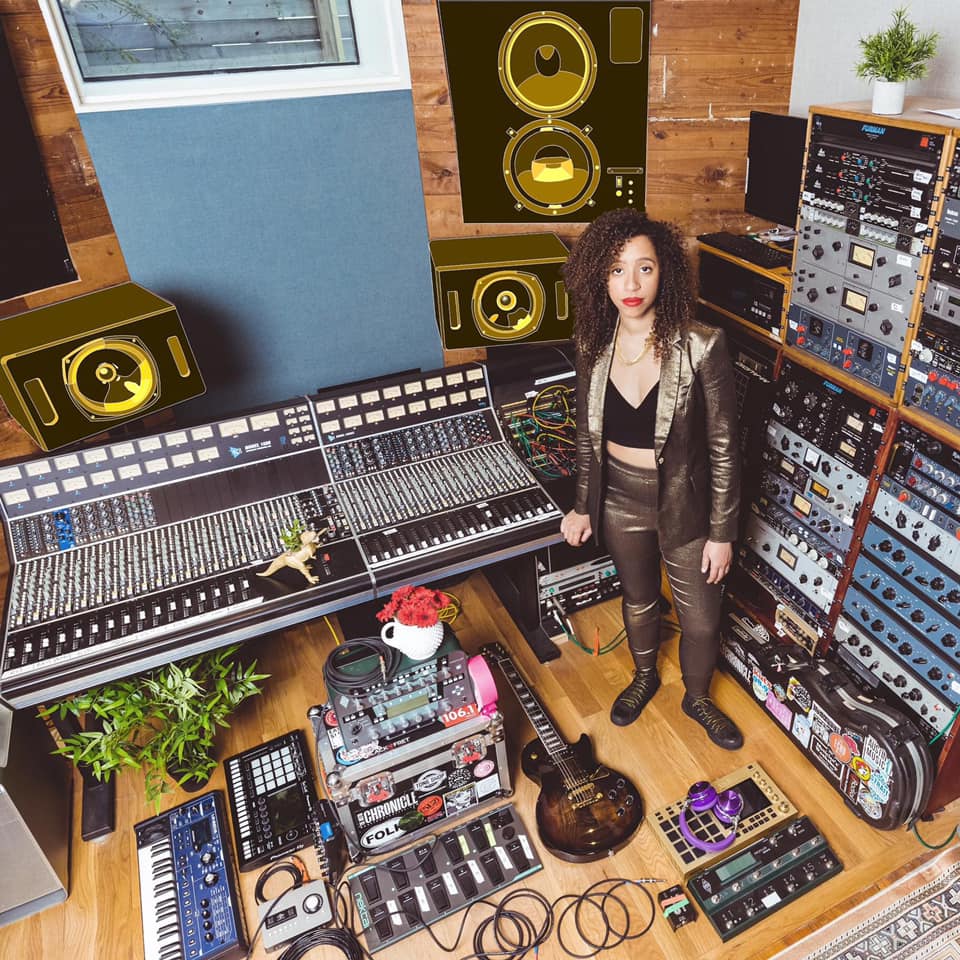
Photo of Jackie by: Ismael Quintanilla III Photography

September 2020 was another strange month in Austin.

The city was still dealing with COVID-19 restrictions, live events remained severely limited, and many of the restaurants, bars and venues that helped define Austin’s personality were trying to figure out how to survive.

But if there was one thing Austin’s restaurant scene proved during that month, it was that the food business wasn’t going to simply disappear.

New places were still opening.

Old favorites were finding ways to adapt.

And unfortunately, some Austin institutions were closing their doors.

One of the month’s more interesting openings came from Carabao Express. The Filipino food truck expanded into a brick-and-mortar restaurant, bringing dishes such as chicken adobo and pancit noodles to a permanent location. The concept also offered Dole Whips, giving customers another reason to check out the new restaurant.

For a city that has always embraced food trucks, the move from truck to restaurant was significant. Austin’s food-truck culture had become one of the city’s biggest culinary calling cards, and seeing a successful truck graduate into a restaurant was a familiar Austin story.

But September also brought one of the saddest announcements of the year.

Maria’s Taco Xpress announced that its longtime South Austin location would close.

For years, Maria’s had been much more than a place to get tacos. It had become part of Austin’s wonderfully strange identity, complete with its famous giant dancing statue. The restaurant’s closure represented another piece of old Austin disappearing during an already difficult year.

There was at least a possibility that the Maria’s name would continue. Owner Maria Corbalan planned to give the name to her employees so they could potentially open a Maria’s trailer somewhere else in Austin.

That was one of the themes of 2020: businesses were closing, but people weren’t necessarily giving up.

Old Thousand was another example of a restaurant continuing to move forward.

The Chinese-American restaurant announced an expansion into Brentwood, adding another location while the hospitality industry was dealing with unprecedented uncertainty.

Of course, September wasn’t all openings.

Austin’s nightlife and entertainment industries continued taking some of the hardest hits.

Buffalo Billiards, a longtime downtown bar, closed permanently during the month. Easy Tiger also closed its original downtown bakery and beer garden, although the company was preparing to open its South Lamar location.

Those closures demonstrated just how dramatically the pandemic had changed downtown Austin.

Businesses that depended on office workers, tourists, conventions, nightlife and large gatherings suddenly had far fewer customers.

The problem wasn’t simply that people weren’t going out.

There weren’t many places for them to go.

Live events were largely gone. Concerts had been canceled. Large gatherings were restricted. Tourism had slowed dramatically.

And restaurants were operating under capacity restrictions and constantly changing rules.

Even catering companies were suffering.

Pink Avocado, a longtime Austin catering company, shut down in September because the lack of live events had devastated its business.

For Austin, that was particularly painful.

Catering is closely connected to the city’s event culture. Weddings, conferences, festivals, corporate parties, concerts and private events all create business for caterers.

When those events disappear, the impact spreads throughout the hospitality industry.

Yet there was still plenty of creativity.

La Barbecue, one of Austin’s most recognizable barbecue names, was experimenting with a completely different product: hot dogs.

The restaurant launched the Red Rocket Wiener Wagon pop-up, showing that even established Austin barbecue businesses were looking for new ways to operate and generate revenue.

September also brought Lola’s Donuts, a new doughnut shop from the owner of Sugar Mama’s. The shop was named after the owner’s grandmother and planned to serve brioche doughnuts and aguas frescas.

That combination — traditional Austin food culture mixed with new ideas — was still very much alive.

And perhaps that is what made September 2020 worth remembering.

Austin wasn’t normal.

Far from it.

But the city’s food scene was still moving.

Some businesses were closing while others were opening.

Some restaurants were moving from food trucks into brick-and-mortar spaces.

Others were expanding.

Established restaurants were experimenting with completely new products.

And businesses that depended on events were trying to find ways to survive without the events.

Looking back, September 2020 was a snapshot of an Austin caught between two worlds.

The old Austin was disappearing faster than anyone expected.

The new Austin was beginning to take shape.

Nobody knew exactly what the city would look like once the pandemic was finally over.

But September made one thing clear:

Austin’s food scene wasn’t giving up.

RIP 2020

Posted by Dominic M | Covid Life

A list of places that have closed permanently due to ongoing pandemic crisis. If restaurant has more than one location, we will list which location closed.

RIP:
Austin Java (all closed, but Menchaca Rd)
Barracuda
B.D. Riley’s
Be More Pacific
Black Walnut Café
Blue Dahlia (East side location)
BT2 Club aka Bout Time
Botticelli’s
The Brewer’s Table
Buffalo Billards
Buzzmill Coffee Shady (East)
Cafe Josie
Cap City Comedy
Chocolaterie Tessa
Dart Bowl
Daruma Ramen
Dirty Dog Bar
Dive Bar & Lounge
Easy Tiger (Downtown)
Fricano’s Deli
Full English
I Luv Video
Luby’s
Lucy’s on the Lake
Magnolia Café (West)
Mugshots
Ni-Kome
The North Door
NXNW
One-2-One Bar
P Terrys (Downtown)
Plush
Scratchouse
Shady Grove
Skull Mechanix
St. Roch’s Bar
Sugar Mama’s (East)
The Townsend
Troublemaker
Threadgill’s
Veggie Heaven
Vulcan Video
Yuyo

If there was ever a month that showed just how much Austin loves its food, drinks and entertainment, August 2020 was it.

Of course, this wasn’t the Austin everybody remembered.

The usual summer routine of packed bars, live music, festivals, crowded restaurants and late nights had been turned upside down by COVID-19. Austin’s food and nightlife businesses were trying to figure out how to survive while following constantly changing restrictions. Some restaurants were leaning heavily into takeout and delivery. Others were creating outdoor dining spaces. Bars remained one of the hardest-hit parts of the hospitality industry.

And yet, somehow, Austin was still Austin.

There were new restaurants opening, new concepts arriving and even a brand-new cider-and-arcade destination opening along Riverside Drive.

One of the biggest new arrivals came on South Congress. Sweetgreen opened its first Austin location at 1007 South Congress Avenue on August 12 as part of the Music Lane development. The restaurant offered both takeout and dine-in service, including an outdoor patio, while putting new pandemic-era procedures in place for customers and employees.

For a city known for tacos, barbecue, burgers and breakfast, the arrival of a national salad chain might not sound like the biggest Austin food story. But the location itself said a lot about where Austin’s food scene was heading.

Sweetgreen wasn’t simply opening another restaurant. It was arriving in one of the city’s most recognizable dining and shopping corridors at a time when almost every restaurant opening felt like a statement that the city’s food scene wasn’t giving up.

The restaurant also made an effort to connect with Austin. Sweetgreen said it would use Texas vendors and ingredients, including Central Texas farms, Texas olive oil and other locally sourced products. Its opening-week promotion also included a partnership benefiting Caritas of Austin.

Then there was Bishop Cidercade.

The long-awaited combination of cider bar and arcade finally opened its Austin location on August 28 at the former Joe’s Crab Shack property at 600 East Riverside Drive.

And this wasn’t a tiny neighborhood bar.

The Austin Cidercade occupied approximately 13,000 square feet and featured more than 24 ciders on draft, along with wine, hard kombucha, soda and pizza. The location also included a patio overlooking the lake and a large collection of arcade games.

The opening was especially notable because it had already been delayed by the pandemic. The Austin location had originally been expected to open earlier in the year, but restrictions on arcades prevented that from happening.

By the end of August, however, Cidercade was finally open.

That was the strange thing about Austin in the summer of 2020. Businesses weren’t simply opening and closing. They were constantly adapting.

Restaurants were changing their menus. Bars were trying to figure out how to operate under restrictions. Businesses were adding outdoor seating, changing ordering procedures and finding new ways to make money.

Even something as simple as getting a drink changed.

In August, restaurants in Texas were allowed to sell mixed alcoholic drinks for takeout and delivery under a new waiver. That might seem completely normal now, but at the time it was another example of how the pandemic was changing the rules for Austin’s restaurant industry.

The month also delivered a much less happy reminder of how serious things had become.

On August 28, the Austin Food & Wine Festival officially canceled its 2020 event.

The festival had originally been scheduled for April before being postponed to November. But with Austin’s restrictions on large gatherings extended into December, organizers ultimately decided that the 2020 festival couldn’t happen.

For Austin, that was a major loss.

Food festivals are part of what makes this city different. They bring chefs, restaurants, food lovers and visitors together in one place. The cancellation wasn’t simply another event disappearing from the calendar. It was another piece of Austin’s normal identity being put on hold.

The festival encouraged people to continue supporting local restaurants through takeout and other forms of assistance, while ticket holders could receive refunds, roll tickets over to 2021 or donate the value of their tickets to the Austin Food & Wine Alliance.

And then there were the businesses that were simply trying to survive.

Few stories captured that better than Donn’s Depot.

The legendary Austin dive bar, located in an old train station and known for live music, was more than 40 years old in 2020. By the end of August, the people behind the Depot were asking longtime customers for help keeping the business alive.

The proposed “Donn’s Depot All Star Subscription Fund” asked supporters to pledge $50 a month, with a goal of finding 250 people willing to contribute. The money would help cover rent, utilities and reopening expenses while the bar remained severely affected by COVID-19 restrictions.

That story probably represents August 2020 better than almost anything else.

Austin still had new restaurants.

Austin still had new bars and entertainment concepts.

Austin still had patios, takeout cocktails, pizza, cider and food trucks.

But underneath all of it was a city trying to figure out how to keep its personality alive.

For a place where going out to eat, grabbing a drink and listening to live music are such a huge part of everyday life, the pandemic created a challenge that nobody had experienced before.

August 2020 wasn’t about pretending everything was normal.

It was about finding whatever version of normal was possible.

A new salad restaurant opened on South Congress.

A cider bar and arcade finally opened on Riverside.

Restaurants found new ways to sell food and drinks.

Food festivals canceled their plans.

And longtime Austin institutions turned to their customers for help.

Looking back, that’s what makes the summer of 2020 so interesting.

Austin’s food and entertainment scene didn’t simply disappear. It changed shape.

Some of those changes lasted only a few months. Others became permanent parts of the city’s restaurant culture.

And some of the businesses that were fighting to survive in August 2020 would eventually become part of Austin’s history.

But at the time, nobody knew how long it would last.

Austin was simply trying to keep the lights on, keep the kitchens running, keep the drinks flowing and find a reason to get out of the house.

Even in one of the strangest summers the city had ever seen, that still sounded a lot like Austin.

There was something almost surreal about opening a giant arcade in Austin in August 2020.

The city was still dealing with a pandemic. Restaurants and bars were operating under restrictions, major events had disappeared from the calendar and Austinites had spent months trying to figure out what “going out” was supposed to look like anymore.

And then, on August 28, Bishop Cidercade opened its doors on Riverside Drive.

The concept was exactly the kind of thing that made sense in Austin under normal circumstances: thousands of square feet of arcade games, a long list of house-made ciders, pizza, a waterfront location and enough space to turn an ordinary night out into an entire evening.

But August 2020 was anything but normal.

The Austin Cidercade had originally been expected to open earlier in the year. The pandemic changed those plans, and the opening was delayed as businesses across the city tried to determine how — or whether — entertainment venues could operate safely.

When the doors finally opened, Bishop Cidercade was taking over the former Joe’s Crab Shack property at 600 East Riverside Drive. The building provided something that many Austin businesses desperately needed during the pandemic: space.

The Cidercade covered roughly 13,000 square feet and offered more than two dozen ciders on draft, along with pizza and other drinks. The arcade contained a large collection of games, giving customers an unusual combination of bar, restaurant and entertainment venue.

In another year, the opening probably would have been treated simply as another major addition to Austin’s entertainment scene.

In 2020, it became something more interesting.

It was a test.

Could an entertainment business built around people standing next to arcade machines, ordering drinks and spending hours inside a building actually operate during a pandemic?

Bishop Cidercade’s answer was to radically change the way the space operated.

The business announced reduced capacity, wider aisles, fewer tables and chairs, mask requirements and extensive sanitation procedures. It was even using specialized equipment to sanitize the facility after hours.

The changes illustrated just how different the Austin nightlife experience had become.

Before COVID-19, people rarely thought about the distance between arcade machines.

Nobody wondered how often a bartender wiped down a game cabinet.

Nobody considered whether an arcade was operating at 30 percent or 50 percent capacity.

In August 2020, those details were suddenly part of the experience.

And that was the strange reality facing Austin’s hospitality industry.

Businesses weren’t simply asking whether customers wanted to come.

They were asking whether customers would feel comfortable coming.

That distinction mattered.

Austin had built much of its reputation on experiences that encouraged people to linger.

Go to a bar and stay for three hours.

Grab food and hang out.

See a band.

Play games.

Drink a few beers.

Meet friends.

The Cidercade concept was practically designed around that kind of behavior.

That made its opening particularly notable.

At the same time, Austin’s traditional entertainment industry was suffering.

Live music had been devastated by the cancellation of SXSW and the shutdown of venues.

Bars were struggling with restrictions.

Restaurants were trying to survive on reduced capacity, takeout and delivery.

Large events had disappeared.

And yet, a new entertainment destination had decided that the time was right to open.

The location itself was another reason the opening attracted attention.

The former Joe’s Crab Shack property on Riverside offered Cidercade something that many downtown businesses couldn’t provide: a large footprint with outdoor space and views toward the water.

That helped the concept fit into the changing Austin entertainment landscape.

Outdoor space had become increasingly valuable.

People wanted somewhere to go, but they also wanted to avoid crowded indoor environments whenever possible.

Cidercade’s combination of indoor arcade games and outdoor space gave customers another option.

It wasn’t the same as Austin before COVID.

Nothing was.

But it was something.

And perhaps that was the most important part of the August 2020 opening.

Austin needed places that reminded people that the city still had a personality.

The pandemic had made everything feel temporary.

Restaurants were closing.

Events were being canceled.

Businesses were changing their hours.

People were staying home.

Against that backdrop, opening a giant arcade and cider bar felt almost rebellious.

It was a statement that Austin’s entertainment culture wasn’t going to disappear.

It was simply going to have to figure out how to survive.

The opening of Cidercade didn’t mean Austin was back to normal.

It wasn’t.

The city still had a long road ahead.

But on August 28, there was a new place on Riverside where Austinites could grab a cider, play an arcade game and spend a few hours doing something that felt almost normal.

For a city that had spent months being told to stay home, that mattered.

And years later, the opening of Cidercade stands as one of those distinctly 2020 Austin stories — a new entertainment destination arriving at exactly the moment when Austin’s entertainment industry was being forced to reinvent itself.

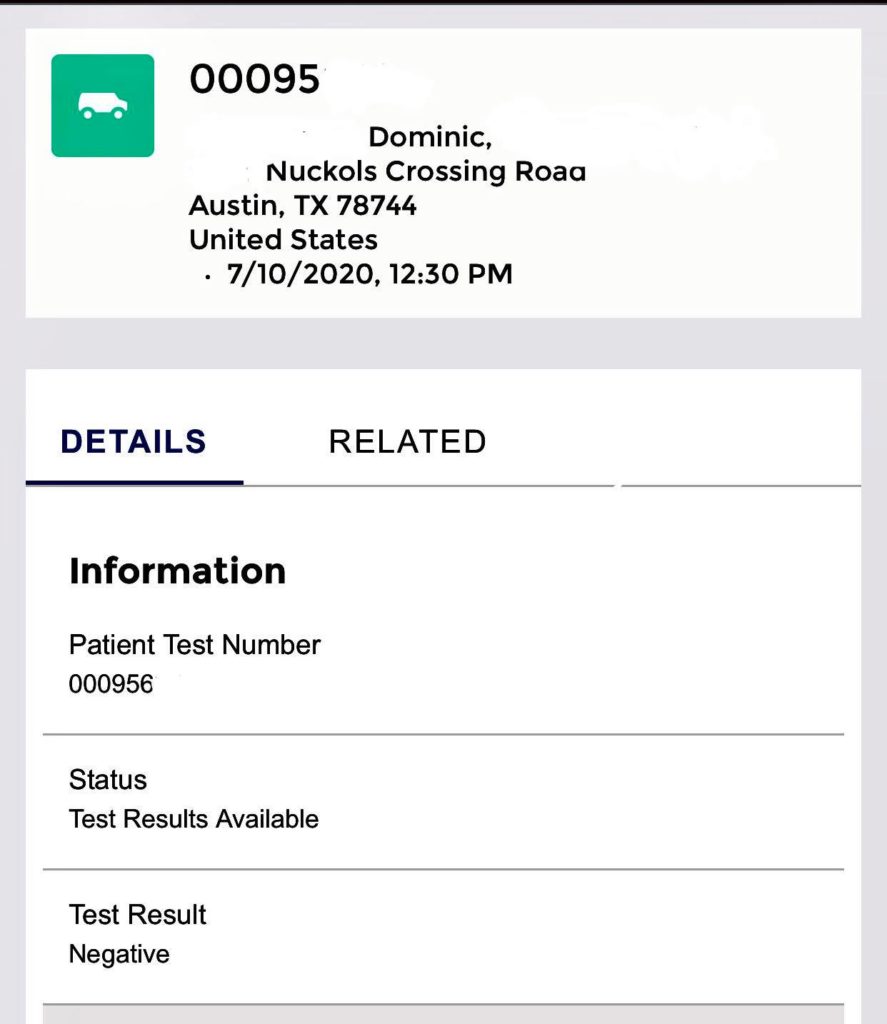
I posted this the other day on my personal Facebook, and wanted to share on here in case anyone is looking to get a COVID-19 test here in Austin and may not have the funds. This is info about a free COVID swab test I took through the City of Austin. First I will start off with the link.

https://covid19.austintexas.gov/

Because I had to go out of state, it was advised that I get tested for COVID-19. I went on the site above, and answered the assessment and based on my responses, it told me I should get a test. You have to create an account first and then put in your personal info with assessment, and testing centers from across the area will pop up. I chose a location a few minutes from my house which happened to be at a library. I did this on Sunday July 5th, and the earliest opening they had was July 10th.

On the day of, I arrived and walked towards the main door. A man came out and handed me a tissue and told me to blow my nose and throw it away. He asked me if I had an appointment or if i was a walk in, and then invited me in and told me to walk up to the 2nd table. It was kind of set up like going to vote. I handed my ID to one of the individuals who asked for it for verification, and then after the person next to her put a nasal swab in a bag, sprayed sanitizer on my hands, and asked me to follow her to the other room. I walked into the other room and they told me to sit down, pull my mask to cover my mouth but expose my nose, and put my head back. They then performed the 10 second test and told me where to walk out (and wash my hands outside).

The process took about 2-3 mins from walking in to walking out. It also wasn’t as painful as I thought. Past flu swabs have hurt more. They said it would take 3-5 days to get results back and I got them back in 4 days, which included the weekend.


Get tested if you are not feeling well, or even if you think it’s just allergies. I suffer from allergies and a sore throat that lingers in me all year. The entire time I was at the testing site I felt safe and everyone was wearing protective gear from head to toe. I know my experience may not be the same as everyone else, but I just wanted to let everyone know there is a free option out there provided by the City of Austin, and both the time at the facility and test results did not take as long as I have heard from other places. I did not have to go to the doctor before hand or have a telemedicine appointment. I simply went to the website and filled out the questionnaire and created an account and booked an appointment. They did not ask me for payment or any personal questions at the testing site and it was as simple as just verifying my ID.

Please stay safe, wear a mask, distance socially when possible, and I hope this helps other people who are searching for low cost/no cost options.

So… my wife & I went out to eat yesterday.

It is our 11th wedding anniversary this weekend and I had talked about it to her about maybe finding a outside place in Austin on Saturday, and she did not want to go out anywhere.

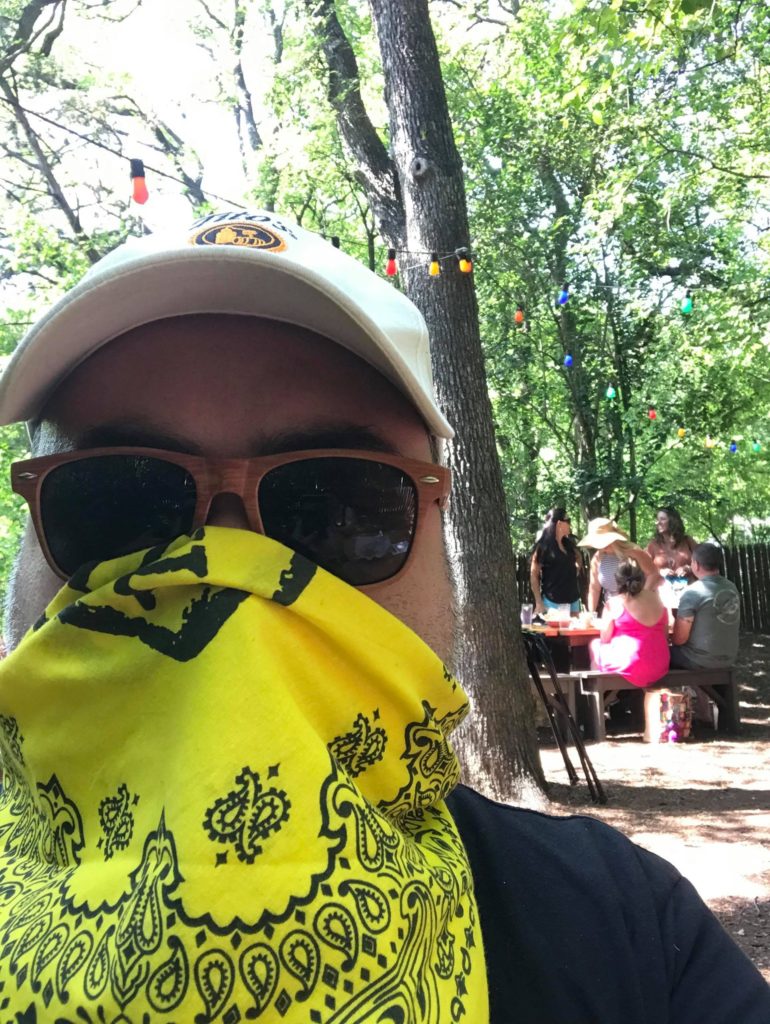
Everyone knows how much of a social person I am, so this has all hit me hard. We were coming back from a funeral in Corpus and had not eaten lunch yet. I know the virus has not impacted small towns the way it has other places in Tx yet so we debated it and came up with a place we both like in Gruene, Tx., which is Cantina Del Rio (an outdoor restaurant). It was lunch on a weekday during the pandemic in a small town so we decided that would be better than trying to go out this Saturday in Austin after the bars have opened back up. We called ahead to ask important questions and everything checked out. When we arrived right away we saw the host staff and front bar staff that is outside the front all wearing mask. The restaurant is 80% under a covered outdoor type of treehouse patio, 10% inside, and 10% completely outside in the back of the place in a backyard garden. We asked to be seated in the backyard. As we walked through the restaurant and were seated, we noticed all the customers eating did not have mask on or around their necks. No customers walking in or out during our visit had mask on going In or coming out as well. However, all the servers and staff in the entire place had mask on the entire visit, except one who had it around her neck. Thankfully she didn’t wait on us. We sat in the back, and there were two other tables seated spaced out 20 feet from us. One table had about 4 people when we arrived and presents on the table. It was obviously a birthday party. Everyone was standing up and hugging each other when people would arrive. 6 people limit went over by 1 and we saw 7 people at their table but didn’t say anything. Then an 8th person showed up and shortly after they made 2 of them move to another table that was 15 feet away from that party. I don’t know if this is the new norm, and 10 years from now it will be like this. We were both nervous, but I think we figured out the perfect spot and time to celebrate a special occasion. I already know I will have a lot of friends working or going out to bars this weekend in cramped spaces, and that many of these bar may not follow established guidelines. Everyone be safe and wear mask as much as you can. If this is the new norm, we need to find ways to be in each other’s lives and still be able to safely practice social distancing with respect to each others bubbles in public spaces. We both are luckily enough to be able to work from home, and until 24 hours ago, I had not been inside a grocery store, gas station, any store in over 2 months. It is weird how so much of the world is living a regular non quarantine life out there like nothing is happening. I love all my friends and family, stay safe.

Death during Covid

Posted by Dominic M | Covid Life

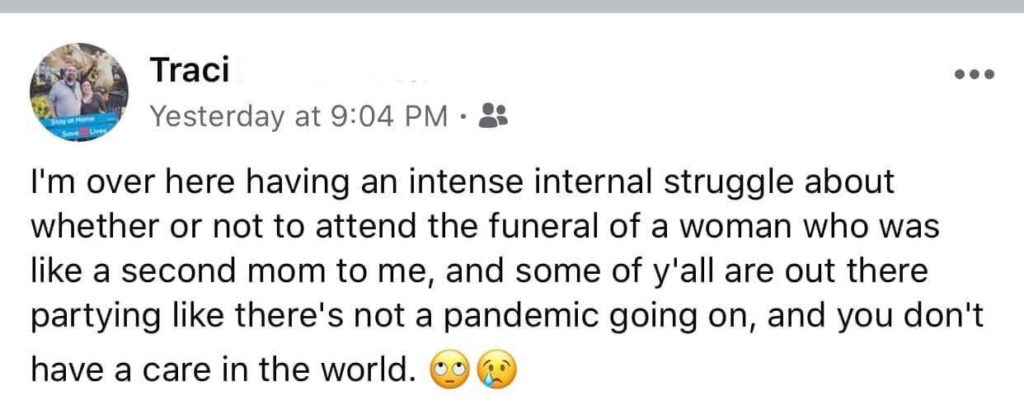
I wrote this (below image) on my personal facebook on May 16th. My wifes Godmother had passed away, unrelated to Coronavirus. At the time all my friends in Austin were social distancing, but I kept seeing friends and family in my Hometown of Corpus Christi, Tx. post pictures at the beach, not social distancing, hugging each other in photo’s and at house parties. The image below was a reflection of me constantly showing my wife pictures of people not practicing safe social distancing. What I wrote are my thoughts, and mine alone.

May 16th, 2020.

“My wife has a cousin, cousins spouse, and child who went to the beach few weekends ago in Corpus Christi and have since tested positive for Covid-19. Her family asked her not to post about it online, but I’m not fb friends with any of them. Instead of asking her to post their stories to educate, warn, and ask people to stay home and protect friends and loved ones, they are embarrassed and asked for silence. This is one of many reasons and examples of how this virus is not going to end anytime soon. Silence is not the cure, and neither is gathering in public. Stay home, stay safe, wear PPE around anyone you don’t live with and help slow the spread of this virus.”